Concept Clerk ★ Priority
What is a committee in CouncilPapers?
A committee is the basic organisational unit in CouncilPapers. Every meeting belongs to a committee, and committees give structure to your council's activity — each one has its own meeting schedule, membership list, default agenda content, and minutes history.
Common examples include Full Council, Planning Committee, Finance Committee, and Personnel Committee — but your council's committees are configured to match your actual structure. A committee in CouncilPapers corresponds directly to a committee (or sub-committee) in your council's constitution.
If you are unsure whether something should be set up as a committee, see When to create a new committee.
What the adopting committee is
Every council has one committee designated as its adopting committee. In almost all cases this is the Full Council.
The adopting committee has a specific responsibility in the minutes lifecycle: it is the committee that formally adopts the minutes of all other committees into the council's official record. Adoption is one of two steps — alongside Approval — that minutes must go through before they are fully published.
The adopting committee designation is set once during your council's initial setup. Every council must have one — CouncilPapers requires it.
What the adopting committee can do that others cannot
The distinction between the adopting committee and all other committees comes down to what options are available when building an agenda.
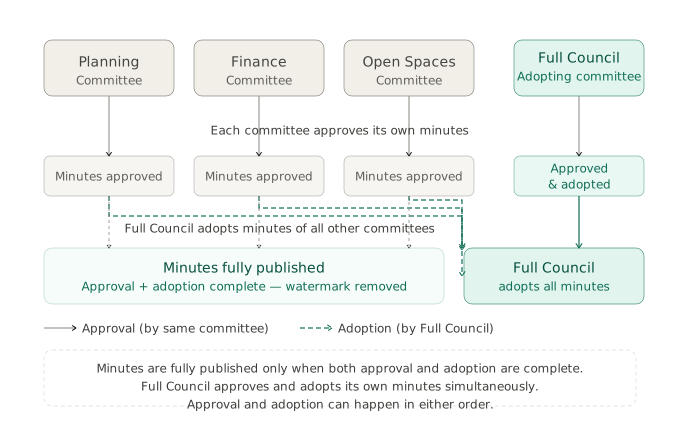
Other committees can only approve their own prior minutes. When the clerk adds a minutes item to a Planning Committee agenda, for example, CouncilPapers will only offer Planning Committee minutes for approval — and only minutes that have not yet been approved. It will never offer minutes from other committees, and it will never offer the option to adopt.
The adopting committee has two additional options available:
- It can approve and adopt its own prior minutes simultaneously, in a single agenda item
- It can adopt the minutes of other committees — handling Adoption separately from the Approval those committees carry out themselves
This means the adopting committee is the only committee that ever sees minutes from across the whole council. All other committees only ever see their own.
Why every council must have one
Without an adopting committee, minutes can be approved by their own committee but can never reach full publication. Adoption is a required step — minutes remain in draft, with the draft watermark, until both Approval and Adoption are complete.
The requirement for an adopting committee reflects standard local council practice: the Full Council is the sovereign body of the council, and formal adoption of minutes into the official record is one of its constitutional responsibilities.
A note on Full Council minutes
Because the Full Council is typically both a committee in its own right and the adopting committee, its minutes go through a slightly different process. When a Full Council meeting is minuted and those minutes are later placed on a Full Council agenda, a single agenda item handles both Approval and Adoption together. One confirmation in the minutes form marks the original minutes as both approved and adopted simultaneously.
For a full description of how this works in practice, see The minutes lifecycle.
Last updated: 12 June 2026
See also
- When to create a new committee Concept
- Setting the adopting committee Procedure
- The minutes lifecycle Concept
Need more help? Contact us
About CouncilPapers
Stop drowning in paperwork
Your meeting preparation shouldn't consume your week. Automate the tedious bits so you can focus on what matters.
Meeting records that stand up to scrutiny
Version-controlled, searchable, audit-proof—your agendas and minutes become a trusted record, not a liability.
Transparent, accessible council papers
Publish professional agendas and minutes to the web instantly. Show your community that decisions are made openly and carefully.